- W
General Election Results 2015
- cloud.csiss.gmu.edu
- data.europa.eu
csv, xlsUpdated May 8, 2015+ more versions Share
Share Facebook
 Twitter
 EmailClick to copy linkLink copiedCiteGreater London Authority (GLA) (2015). General Election Results 2015 [Dataset]. https://cloud.csiss.gmu.edu/uddi/vi/dataset/general-election-results-2015csv, xlsAvailable download formatsDataset updatedMay 8, 2015Dataset provided byGreater London Authority (GLA)Description
The results for each candidate standing in all 73 seats in Greater London are available as an Excel file. The data is also presented as an interactive map below.
The files includes election results from the last three parliamentary constituency elections between 2005 to 2015.
The results presented here include turnout, majority and percentage of vote for each candidate that stood in the election that took place on 7 May 2015.
Read the blog, The 2015 election – the numbers behind the result, which analyses some of the results.
https://londondatastore-upload.s3.amazonaws.com/images/seats-chart-2015.png" alt="">
https://londondatastore-upload.s3.amazonaws.com/images/share-chart-2015.png" alt="">
London Maps
The London data is presented in this interactive Instant Atlas report.

UK Maps
Some interactive maps of the UK results have been created using Tableau.

Voting intention in the United Kingdom 2025, by age
- statista.com
ShareFacebookTwitterEmailClick to copy linkLink copiedCiteStatista, Voting intention in the United Kingdom 2025, by age [Dataset]. https://www.statista.com/statistics/1379439/uk-election-polls-by-age/Time period coveredOct 5, 2025 - Oct 6, 2025Area coveredUnited KingdomDescriptionAs of October 2025, the political party that 18 to 24 year-old's in Great Britain would be most likely to vote for was the Labour Party, at 30 percent, with Labour also the joint-most popular party among those aged 25 to 49 along with Reform UK. Reform was the most popular party for the 50 to 64 age group, with 32 percent of voters saying they would vote for them. For the oldest age group, Reform was also the most popular, with 31 percent of over 65s intending to vote for them. Reform surge in the polls Since winning the last UK general election in July 2024, the ruling Labour Party have steadily become more unpopular among voters. After winning 33.7 percent of the vote in that election, the party was polling at 24 percent in April 2025, only slightly ahead of Reform UK on 23 percent. A right-wing populist party, Reform benefited from the collapse in support for the center-right Conservative Party in the last election, winning several seats at their expense. While the next UK general election is not due to be held until 2029, the government will be keen to address their collapsing approval ratings, in the face of Reform's rising support. Economic headaches for Labour in 2025 Although Labour inherited a growing economy, with falling inflation, and low unemployment from the Conservatives, the overall economic outlook for the UK is still quite gloomy. The country's government debt is around 100 percent of GDP, and without large tax rises and spending cuts, the government hopes to create a stronger, more resilient economy to reduce the deficit. While this is still a possibility, the UK's economic prospects for 2025 were recently slashed, with growth of one percent forecast, down from an earlier prediction of two percent. Although mainly due to external factors such as the threat of increasing tariffs, and general geopolitical instability, the UK's faltering economy will add further problems to the embattled government.
- e
Borough Council Election Results 2014
- data.europa.eu
excel xls, pdfUpdated Dec 1, 2014+ more versionsShareFacebookTwitterEmailClick to copy linkLink copiedCiteGreater London Authority (2014). Borough Council Election Results 2014 [Dataset]. https://data.europa.eu/data/datasets/borough-council-election-results-2014excel xls, pdfAvailable download formatsDataset updatedDec 1, 2014Dataset authored and provided byGreater London AuthorityDescription
This report includes a great deal of detail on every aspect of the 2014 London Borough council general elections. No other single volume presents the full results and election statistics from the 32 London boroughs enabling the reader to analyse and compare the results across London in one place. The report presents data for every candidate in every ward (excluding the City of London which operates on a different electoral model). The report also contains analysis of the European election results for London that took place on the same day.
Printed Copies We are able to accept orders for hard copies £30. Click here for further details.
Details of all previous elections reports in the series can be found here.
Summary results of the 2014 local elections in London, showing number and percentage of seats won, turnout and political control.
Final 2014 ward results
These results show the number of votes for each candidate in each ward in London. Turnout, number of ballots, postal votes, and breakdown of rejected votes, Mayoral and European voting figures are also included where available.
Map showing political control in each ward.
https://londondatastore-upload.s3.amazonaws.com/images/London-ward-map-borough-election-2014-new-colours-small.png" alt="">
Also, using these ward results, Oliver O'Brien from CASA has created some eye catching interactive ward maps.
The borough map shows the summary results in both the 2010 and 2014 elections.
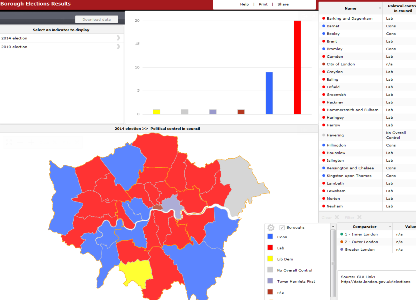
The ward interactive map shows the detailed results for each candidate at ward level for the last three elections between 2006 and 2014.

This motion chart shows the relationship, between share of votes and seats won by the major parties in elections since 1964 at borough level (requires Adobe Flash Player).
 )
) General Election Results 2015 - Dataset - data.gov.uk
- ckan.publishing.service.gov.uk
Updated Jun 9, 2025ShareFacebookTwitterEmailClick to copy linkLink copiedCiteckan.publishing.service.gov.uk (2025). General Election Results 2015 - Dataset - data.gov.uk [Dataset]. https://ckan.publishing.service.gov.uk/dataset/general-election-results-20151Dataset updatedJun 9, 2025DescriptionThe results for every constituency in the United Kingdom, including Greater London's 73 seats are available to download as an Excel file. The Greater Londoo Authority have produced a blog and and some interactive maps This data is published by the Electoral Commission.
UK Parliamentary Constituency boundaries for the island of Ireland,...
- zenodo.org
- data-staging.niaid.nih.gov
binUpdated Oct 25, 2024ShareFacebookTwitterEmailClick to copy linkLink copiedCiteCharlton Martin; Charlton Martin; Eoin McLaughlin; Eoin McLaughlin; Jack Kavanagh; Jack Kavanagh (2024). UK Parliamentary Constituency boundaries for the island of Ireland, 1885-1918 [Dataset]. http://doi.org/10.5281/zenodo.13993331binAvailable download formatsUnique identifierhttps://doi.org/10.5281/zenodo.13993331Dataset updatedOct 25, 2024AuthorsCharlton Martin; Charlton Martin; Eoin McLaughlin; Eoin McLaughlin; Jack Kavanagh; Jack KavanaghLicenseAttribution 4.0 (CC BY 4.0)https://creativecommons.org/licenses/by/4.0/
License information was derived automaticallyTime period covered2017Area coveredIreland, Ireland, United KingdomDescriptionThe 1885 UK parliamentary constituencies for Ireland were re-created in 2017 as part of a conference paper delivered at the Southern Irish Loyalism in Context conference at Maynooth University. The intial map only included the territory of the Irish Free State and was created by Martin Charlton and Jack Kavanagh. The remaining six counties of Ulster were completed by Eoin McLaughlin in 2018-19, the combined result is a GIS map of all the parliamentary constituecies across the island of Ireland for the period 1885-1918. The map is available in both ESRI Shapefile format and as a GeoPackage (GPKG). The methodology for creating the constituencies is outlined in detail below.
Methodology
A map showing the outlines of the 1855 – 1918 Constituency boundaries can be found on page 401 of Parliamentary Elections in Ireland, 1801-1922 (Dublin, 1978) by Brian Walker. This forms the basis for the creation of a set of digital boundaries which can then be used in a GIS. The general workflow involves allocating an 1885 Constituency identifier to each of the 309 Electoral Divisions present in the boundaries made available for the 2011 Census of Population data release by CSO. The ED boundaries are available in ‘shapefile’ format (a de facto standard for spatial data transfer). Once a Constituency identifier has been given to each ED, the GIS operation known as ‘dissolve’ is used to remove the boundaries between EDs in the same Constituency. To begin with Walker’s map was scanned at 1200 dots per inch in JPEG form. A scanned map cannot be linked to other spatial data without undergoing a process known as georeferencing. The CSO boundaries are available with spatial coordinates in the Irish National Grid system. The goal of georeferencing is to produce a rectified version of the map together with a world file. Rectification refers to the process of recomputing the pixel positions in the scanned map so that they are oriented with the ING coordinate system; the world file contains the extent in both the east-west and north-south directions of each pixel (in metres) and the coordinates of the most north-westerly pixel in the rectified image.
Georeferencing involves the identification of Ground Control Points – these are locations on the scanned map for which the spatial coordinates in ING are known. The Georeferencing option in ArcGIS 10.4 makes this a reasonably pain free task. For this map 36 GCPs were required for a local spline transformation. The Redistribution of Seats Act 1885 provides the legal basis for the constituencies to be used for future elections in England, Wales, Scotland and Ireland. Part III of the Seventh Schedule of the Act defines the Constituencies in terms of Baronies, Parishes (and part Parishes) and Townlands for Ireland. Part III of the Sixth Schedule provides definitions for the Boroughs of Belfast and Dublin.
The CSO boundary collection also includes a shapefile of Barony boundaries. This makes it possible code a barony in two ways: (i) allocated completely to a Division or (ii) split between two Divisions. For the first type, the code is just the division name, and for the second the code includes both (or more) division names. Allocation of these names to the data in the ED shapefile is accomplished by a spatial join operation. Recoding the areas in the split Baronies is done interactively using the GIS software’s editing option. EDs or groups of EDs can be selected on the screen, and the correct Division code updated in the attribute table. There are a handful of cases where an ED is split between divisions, so a simple ‘majority’ rule was used for the allocation. As the maps are to be used at mainly for displaying data at the national level, a misallocation is unlikely to be noticed. The final set of boundaries was created using the dissolve operation mentioned earlier. There were a dozen ED that had initially escaped being allocated a code, but these were quickly updated. Similarly, a few of the EDs in the split divisions had been overlooked; again updating was painless. This meant that the dissolve had to be run a few more times before all the errors have been corrected.
For the Northern Ireland districts, a slightly different methodology was deployed which involved linking parishes and townlands along side baronies, using open data sources from the OSM Townlands.ie project and OpenData NI.
- a
Elections
- hub.arcgis.com
- opendata.wigan.gov.uk
- +1more
Updated Jul 20, 2022+ more versionsShareFacebookTwitterEmailClick to copy linkLink copiedCiteWigan Council (2022). Elections [Dataset]. https://hub.arcgis.com/maps/Wigan::legacy-polling-districts/aboutDataset updatedJul 20, 2022Dataset authored and provided byWigan CouncilArea coveredDescriptionBoundary of polling districts, and location of polling stations in Wigan
- g
Borough Council Election Results 2018
- gimi9.com
- data.europa.eu
Updated Mar 14, 2011+ more versionsShareFacebookTwitterEmailClick to copy linkLink copiedCite(2011). Borough Council Election Results 2018 [Dataset]. https://gimi9.com/dataset/uk_borough-council-election-results-2018/Dataset updatedMar 14, 2011LicenseCC0 1.0 Universal Public Domain Dedicationhttps://creativecommons.org/publicdomain/zero/1.0/
License information was derived automaticallyDescriptionWith the aim of making the democratic process as transparent as possible to the London electorate, this report includes a great deal of detail on every aspect of the 2018 London Borough council elections. No other single volume presents the full results and election statistics from the 32 London boroughs enabling the reader to analyse and compare the results across London in one place. The report presents data for every candidate in every ward (excluding the City of London which operates on a different electoral model). Summaries are provided in the form of maps and tables, and to make comparisons easier, they mostly match those included in the 2014 report. Results of all council by-elections between the general elections in 2014 and 2018, as well as details of the elections in the four boroughs that directly elect a mayor, are also presented here. A commentary of the results, written by Professor Tony Travers of the London School of Economics, has been included to give readers an overview of the trends seen in these elections. This is the latest report in a long series of council election reports dating back to 1964, all of which are currently available on the London Datastore at: http://data.london.gov.uk/elections
- g
Borough Council Election Results 2022
- gimi9.com
Updated Mar 14, 2011+ more versionsShareFacebookTwitterEmailClick to copy linkLink copiedCite(2011). Borough Council Election Results 2022 [Dataset]. https://gimi9.com/dataset/eu_borough-council-election-results-2022_1Dataset updatedMar 14, 2011LicenseCC0 1.0 Universal Public Domain Dedicationhttps://creativecommons.org/publicdomain/zero/1.0/
License information was derived automaticallyDescriptionWith the aim of making the democratic process as transparent as possible to the London electorate, this report includes a great deal of detail on every aspect of the 2022 London Borough council elections. No other single volume presents the full results and election statistics from the 32 London boroughs enabling the reader to analyse and compare the results across London in one place. The report presents data for every candidate in every ward (excluding the City of London which operates on a different electoral model). Summaries are provided in the form of maps and tables, and to make comparisons easier, they mostly match those included in the 2018 report. A commentary of the results, written by Professor Tony Travers of the London School of Economics, has been included to give readers an overview of the trends seen in these elections. This is the latest report in a long series of council election reports dating back to 1964, all of which are currently available on the London Datastore at: http://data.london.gov.uk/elections
- a
County Electoral Division (May 2024) Names and Codes in EN
- hub.arcgis.com
- geoportal.statistics.gov.uk
Updated Nov 27, 2024+ more versionsShareFacebookTwitterEmailClick to copy linkLink copiedCiteOffice for National Statistics (2024). County Electoral Division (May 2024) Names and Codes in EN [Dataset]. https://hub.arcgis.com/maps/ons::county-electoral-division-may-2024-names-and-codes-in-enDataset updatedNov 27, 2024Dataset authored and provided byOffice for National StatisticsLicensehttps://www.ons.gov.uk/methodology/geography/licenceshttps://www.ons.gov.uk/methodology/geography/licences
Area coveredDescriptionThis file contains the names and codes for County Electoral Divisions in England as at 2nd May 2024. (File Size - 40 KB) Field Names – CED24CD, CED24NMField Types – Text, TextField Lengths – 9, 47
Council Elections candidate results by ward, 2006 - Dataset - data.gov.uk
- ckan.publishing.service.gov.uk
Updated Mar 23, 2017ShareFacebookTwitterEmailClick to copy linkLink copiedCiteckan.publishing.service.gov.uk (2017). Council Elections candidate results by ward, 2006 - Dataset - data.gov.uk [Dataset]. https://ckan.publishing.service.gov.uk/dataset/council-elections-candidate-results-by-ward-2006Dataset updatedMar 23, 2017DescriptionVoting statistics for the local elections in 2006, includes data on each candidate. Data on turnout can also be accessed via the Excel spreadsheet. More borough level data from this election can be found here. This report gives a detailed breakdown of election facts and figures, including results, full ward voting statistics, a list of all candidates, and a number of maps. This is the latest in a series of publications on London elections dating back to 1964.
- a
UK Parliament General Election June 2017 (results)
- hub.arcgis.com
- data-ren.opendata.arcgis.com
Updated Jan 9, 2018+ more versionsShareFacebookTwitterEmailClick to copy linkLink copiedCiteRenfrewshire Council (2018). UK Parliament General Election June 2017 (results) [Dataset]. https://hub.arcgis.com/maps/ren::uk-parliament-general-election-june-2017-resultsDataset updatedJan 9, 2018Dataset authored and provided byRenfrewshire CouncilLicenseOpen Government Licence 3.0http://www.nationalarchives.gov.uk/doc/open-government-licence/version/3/
License information was derived automaticallyArea coveredUnited KingdomDescriptionUK Parliament General Election 8 June 2017 results for Paisley and Renfrewshire North and Paisley and Renfrewshire South.
- s
European Electoral Regions (December 2018) Boundaries UK BGC
- geoportal.statistics.gov.uk
Updated Jun 27, 2019+ more versionsShareFacebookTwitterEmailClick to copy linkLink copiedCiteOffice for National Statistics (2019). European Electoral Regions (December 2018) Boundaries UK BGC [Dataset]. https://geoportal.statistics.gov.uk/maps/ons::european-electoral-regions-december-2018-boundaries-uk-bgc-2Dataset updatedJun 27, 2019Dataset authored and provided byOffice for National StatisticsLicensehttps://www.ons.gov.uk/methodology/geography/licenceshttps://www.ons.gov.uk/methodology/geography/licences
Area coveredDescriptionThis file contains the digital vector boundaries for European Electoral Regions in the United Kingdom, as at December 2018. The BGC boundaries generalised (20m) - clipped to the coastline (Mean High Water mark). Contains both Ordnance Survey and ONS Intellectual Property Rights.REST URL of ArcGIS for INSPIRE View Service – https://services1.arcgis.com/ESMARspQHYMw9BZ9/arcgis/rest/services/EER_(Dec_2018)_GCB_UK/MapServerREST URL of ArcGIS for INSPIRE Feature DownloadService – https://dservices1.arcgis.com/ESMARspQHYMw9BZ9/arcgis/services/EER_Dec_2018_Generalised_Clipped_Boundaries_UK/WFSServer?service=wfs&request=getcapabilitiesREST URL of Feature Access Service – https://services1.arcgis.com/ESMARspQHYMw9BZ9/arcgis/rest/services/EER_Dec_2018_GCB_UK_2022/FeatureServer
- e
OS Wahlkarten
- data.europa.eu
unknownShareFacebookTwitterEmailClick to copy linkLink copiedCiteOrdnance Survey, OS Wahlkarten [Dataset]. https://data.europa.eu/data/datasets/os-election-maps?locale=deunknownAvailable download formatsDescriptionNutzen Sie unsere Wahlkarten für Großbritannien und Nordirland, um die Wahlgeographie Großbritanniens zu erfahren.
Sie werden die Web-Apps besonders nützlich finden, wenn Sie ein gewählter Vertreter, Kandidat oder Parteiarbeiter sind, da sie die Wahlkreise vor verschiedenen Skalen des Mapping-Hintergrunds deutlich zeigen.
Sie können aus einer Vielzahl von Verwaltungs- und Wahlgrenzen wählen, die auf dem Mapping überlagert werden können.
Die für Großbritannien und Nordirland angegebenen Wahlgrenzen sind die zum 1. Oktober 2020 geltenden.
European Electoral Regions (December 2017) Boundaries UK BSC
- geoportal.statistics.gov.uk
- arc-gis-hub-home-arcgishub.hub.arcgis.com
- +1more
Updated Apr 18, 2018ShareFacebookTwitterEmailClick to copy linkLink copiedCiteOffice for National Statistics (2018). European Electoral Regions (December 2017) Boundaries UK BSC [Dataset]. https://geoportal.statistics.gov.uk/datasets/ons::european-electoral-regions-december-2017-boundaries-uk-bsc/aboutDataset updatedApr 18, 2018Licensehttps://www.ons.gov.uk/methodology/geography/licenceshttps://www.ons.gov.uk/methodology/geography/licences
Area coveredDescriptionThis file contains the digital vector boundaries for European Electoral Regions in UK, as at December 2017. The boundaries are super generalised (200m) - clipped to the coastline (Mean High Water mark). Contains both Ordnance Survey and ONS Intellectual Property Rights.REST URL of ArcGIS for INSPIRE View Service – https://services1.arcgis.com/ESMARspQHYMw9BZ9/arcgis/rest/services/European_Electoral_Regions_(Dec_2017)_UK_BSC/MapServerREST URL of ArcGIS for INSPIRE Feature DownloadService – https://dservices1.arcgis.com/ESMARspQHYMw9BZ9/arcgis/services/European_Electoral_Regions_December_2017_UK_BSC/WFSServer?service=wfs&request=getcapabilitiesREST URL of Feature Access Service – https://services1.arcgis.com/ESMARspQHYMw9BZ9/arcgis/rest/services/European_Electoral_Regions_Dec_2017_UK_BSC_2022/FeatureServer
European Electoral Regions (December 2018) Boundaries UK BUC
- open-geography-portalx-ons.hub.arcgis.com
- geoportal.statistics.gov.uk
- +1more
Updated Jun 27, 2019+ more versionsShareFacebookTwitterEmailClick to copy linkLink copiedCiteOffice for National Statistics (2019). European Electoral Regions (December 2018) Boundaries UK BUC [Dataset]. https://open-geography-portalx-ons.hub.arcgis.com/maps/ons::european-electoral-regions-december-2018-boundaries-uk-bucDataset updatedJun 27, 2019Licensehttps://www.ons.gov.uk/methodology/geography/licenceshttps://www.ons.gov.uk/methodology/geography/licences
Area coveredDescriptionThis file contains the digital vector boundaries for European Electoral Regions in the United Kingdom, as at December 2018. The BUC boundaries are ultra generalised (500m) - clipped to the coastline (Mean High Water mark). Contains both Ordnance Survey and ONS Intellectual Property Rights.REST URL of ArcGIS for INSPIRE View Service – https://services1.arcgis.com/ESMARspQHYMw9BZ9/arcgis/rest/services/EER_(Dec_2018)_UGCB_UK/MapServerREST URL of ArcGIS for INSPIRE Feature DownloadService – https://dservices1.arcgis.com/ESMARspQHYMw9BZ9/arcgis/services/EER_Dec_2018_Ultra_Generalised_Clipped_Boundaries_UK/WFSServer?service=wfs&request=getcapabilitiesREST URL of Feature Access Service – https://services1.arcgis.com/ESMARspQHYMw9BZ9/arcgis/rest/services/EER_Dec_2018_UGCB_UK_2022/FeatureServer
- e
County Electoral Division (May 2017) Names and Codes in EN
- data.europa.eu
- geoportal.statistics.gov.uk
- +1more
csv, geojson, html +3Updated May 15, 2017+ more versionsShareFacebookTwitterEmailClick to copy linkLink copiedCiteOffice for National Statistics (2017). County Electoral Division (May 2017) Names and Codes in EN [Dataset]. https://data.europa.eu/88u/dataset/county-electoral-division-may-2017-names-and-codes-in-enkml, csv, zip, geojson, unknown, htmlAvailable download formatsDataset updatedMay 15, 2017Dataset authored and provided byOffice for National StatisticsDescriptionThis file contains the names and codes for County Electoral Divisions in England as at 4 May 2017. (File Size - 192 KB)
Field Names – CED17CD, CED17NM
Field Types – Text, Text
Field Lengths – 9, 55REST URL of Feature Access Service – https://services1.arcgis.com/ESMARspQHYMw9BZ9/arcgis/rest/services/County_Electoral_Division_May_2017_Names_and_Codes_for_England_2022/FeatureServer European Electoral Regions (December 2016) Full Clipped Boundaries in Great...
- data.gov.uk
- data.europa.eu
- +1more
csv, geojson, html +2Updated Jun 12, 2017+ more versionsShareFacebookTwitterEmailClick to copy linkLink copiedCiteOffice for National Statistics (2017). European Electoral Regions (December 2016) Full Clipped Boundaries in Great Britain [Dataset]. https://data.gov.uk/dataset/cd2f9b1c-fc75-45c5-94c0-8e705186e2b8/european-electoral-regions-december-2016-full-clipped-boundaries-in-great-britainzip, kml, html, csv, geojsonAvailable download formatsDataset updatedJun 12, 2017LicenseOpen Government Licence 3.0http://www.nationalarchives.gov.uk/doc/open-government-licence/version/3/
License information was derived automaticallyArea coveredEurope, United KingdomDescriptionThis file contains the digital vector boundaries for European Electoral Regions in Great Britain as at 31 December 2016.
The boundaries available are:
- Full resolution - extent of the realm (usually this is the Mean Low Water mark but in some cases boundaries extend beyond this to include off shore islands);
- Full resolution - clipped to the coastline (Mean High Water mark);
- Generalised (20m) - clipped to the coastline (Mean High Water mark);
- Super generalised (200m) - clipped to the coastline (Mean High Water mark) and
- Ultra generalised (500m) - clipped to the coastline (Mean High Water mark).
Contains both Ordnance Survey and ONS Intellectual Property Rights.Download File Sizes- Full resolution - extent of the realm (26 MB)
- Full resolution - clipped to the coastline (31 MB)
- Generalised (20m) - clipped to the coastline (4 MB)
- Super generalised (200m) - clipped to the coastline (583 KB)
- Ultra generalised (500m) - clipped to the coastline (197 KB).
REST URL of ArcGIS for INSPIRE View Service – https://ons-inspire.esriuk.com/arcgis/rest/services/Electoral_Boundaries/European_Electoral_Regions_December_2016_Boundaries/MapServer/exts/InspireViewREST URL of ArcGIS for INSPIRE Feature Download Service – https://ons-inspire.esriuk.com/arcgis/rest/services/Electoral_Boundaries/European_Electoral_Regions_December_2016_Boundaries/MapServer/exts/InspireFeatureDownloadREST URL of ArcGIS Feature Service – https://ons-inspire.esriuk.com/arcgis/rest/services/Electoral_Boundaries/European_Electoral_Regions_December_2016_Boundaries/FeatureServer- b
Polling stations
- opendata.bristol.gov.uk
Updated Jan 17, 2014ShareFacebookTwitterEmailClick to copy linkLink copiedCiteBristol City Council (2014). Polling stations [Dataset]. https://opendata.bristol.gov.uk/maps/bcc::polling-stations/aboutDataset updatedJan 17, 2014Dataset authored and provided byBristol City CouncilArea coveredDescriptionLocations of polling stations within the City of Bristol.
London Elections Results 2016, Wards, Boroughs, Constituency
- data.europa.eu
excel xlsUpdated May 27, 2016+ more versionsShareFacebookTwitterEmailClick to copy linkLink copiedCiteGreater London Authority (2016). London Elections Results 2016, Wards, Boroughs, Constituency [Dataset]. https://data.europa.eu/data/datasets/london-elections-results-2016-wards-boroughs-constituency?locale=ltexcel xlsAvailable download formatsDataset updatedMay 27, 2016Area coveredLondonDescriptionDATA
The results for the Mayoral and Assembly elections down to constituency level are available (including turnout and spoils etc).
- All Geographies - This spreadsheet includes data for Constituencies, Boroughs, Wards and postal votes. Also includes turnout figures and first choice by second choice Mayoral vote matrices.
- Detailed Constituencies - Contains more detailed data at Constituency level. Includes percentages and a table showing how the London-wide assembly seats were allocated.
- Time series - Contains elections data from 2000 to 2016 for Constituency and Borough level.
Please note that due to boundary changes, 2016 ward data is not comparable with previous years' data.
INTERACTIVE MAPPING
The 2000-2012 election data for wards, boroughs, and constituencies is presented using interactive maps and charts in an InstantAtlas report. Click on the image below to launch the tool.

More info on the 2016 elections can be found on the London Elects website.
LSOA (2001) to Electoral Ward (December 2010) Best Fit Lookup in EW
- open-geography-portalx-ons.hub.arcgis.com
- hub.arcgis.com
- +1more
Updated Jul 23, 2022+ more versionsShareFacebookTwitterEmailClick to copy linkLink copiedCiteOffice for National Statistics (2022). LSOA (2001) to Electoral Ward (December 2010) Best Fit Lookup in EW [Dataset]. https://open-geography-portalx-ons.hub.arcgis.com/datasets/ons::lsoa-2001-to-electoral-ward-december-2010-best-fit-lookup-in-ewDataset updatedJul 23, 2022Licensehttps://www.ons.gov.uk/methodology/geography/licenceshttps://www.ons.gov.uk/methodology/geography/licences
Area coveredDescriptionA best fit lookup between 2001 lower layer super output areas (LSOA) and electoral wards/divisions as at 31 December 2010. (File Size - 2 MB)
For more information and an overview of best-fitting follow this link - https://geoportal.statistics.gov.uk/datasets/f0aac7ccbfd04cda9eb03e353c613faa/about
REST URL of Feature Access Service – https://services1.arcgis.com/ESMARspQHYMw9BZ9/arcgis/rest/services/LSOA01_WD10_EW_LU_9c4d7d12844340bfa520f5287c52b1c3/FeatureServer
FacebookTwitterEmailGeneral Election Results 2015
The results for each candidate standing in all 73 seats in Greater London are available as an Excel file. The data is also presented as an interactive map below.
The files includes election results from the last three parliamentary constituency elections between 2005 to 2015.
The results presented here include turnout, majority and percentage of vote for each candidate that stood in the election that took place on 7 May 2015.
Read the blog, The 2015 election – the numbers behind the result, which analyses some of the results.
https://londondatastore-upload.s3.amazonaws.com/images/seats-chart-2015.png" alt="">
https://londondatastore-upload.s3.amazonaws.com/images/share-chart-2015.png" alt="">
London Maps
The London data is presented in this interactive Instant Atlas report.
UK Maps
Some interactive maps of the UK results have been created using Tableau.