- f
Clusters with significantly different ReHo Ratio between the two APOE groups...
- datasetcatalog.nlm.nih.gov
- plos.figshare.com
Updated Feb 19, 2013 Share
Share Facebook
 Twitter
 EmailClick to copy linkLink copiedCiteWang, De-Yi; Yan, Chao-Gan; Han, Xiu-Jie; Kiviniemi, Vesa; Liu, Dong-Qiang; He, Yong; Zhu, Chao-Zhe; Zuo, Xi-Nian; Zang, Yu-Feng; Li, Su-Fang (2013). Clusters with significantly different ReHo Ratio between the two APOE groups in Encoding-related ROI. [Dataset]. https://datasetcatalog.nlm.nih.gov/dataset?q=0001617790Dataset updatedFeb 19, 2013AuthorsWang, De-Yi; Yan, Chao-Gan; Han, Xiu-Jie; Kiviniemi, Vesa; Liu, Dong-Qiang; He, Yong; Zhu, Chao-Zhe; Zuo, Xi-Nian; Zang, Yu-Feng; Li, Su-FangDescription
Clusters with significantly different ReHo Ratio between the two APOE groups in Encoding-related ROI.
- f
Data_Sheet_1_Age Differences in Encoding-Related Alpha Power Reflect...
- frontiersin.figshare.com
pdfUpdated Jun 1, 2023ShareFacebookTwitterEmailClick to copy linkLink copiedCiteCaroline Beese; Benedict Vassileiou; Angela D. Friederici; Lars Meyer (2023). Data_Sheet_1_Age Differences in Encoding-Related Alpha Power Reflect Sentence Comprehension Difficulties.pdf [Dataset]. http://doi.org/10.3389/fnagi.2019.00183.s001pdfAvailable download formatsUnique identifierhttps://doi.org/10.3389/fnagi.2019.00183.s001Dataset updatedJun 1, 2023Dataset provided byFrontiersAuthorsCaroline Beese; Benedict Vassileiou; Angela D. Friederici; Lars MeyerLicenseAttribution 4.0 (CC BY 4.0)https://creativecommons.org/licenses/by/4.0/
License information was derived automaticallyDescriptionWhen sentence processing taxes verbal working memory, comprehension difficulties arise. This is specifically the case when processing resources decline with advancing adult age. Such decline likely affects the encoding of sentences into working memory, which constitutes the basis for successful comprehension. To assess age differences in encoding-related electrophysiological activity, we recorded the electroencephalogram from three age groups (24, 43, and 65 years). Using an auditory sentence comprehension task, age differences in encoding-related oscillatory power were examined with respect to the accuracy of the given response. That is, the difference in oscillatory power between correctly and incorrectly encoded sentences, yielding subsequent memory effects (SME), was compared across age groups. Across age groups, we observed an age-related SME inversion in the alpha band from a power decrease in younger adults to a power increase in older adults. We suggest that this SME inversion underlies age-related comprehension difficulties. With alpha being commonly linked to inhibitory processes, this shift may reflect a change in the cortical inhibition–disinhibition balance. A cortical disinhibition may imply enriched sentence encoding in younger adults. In contrast, resource limitations in older adults may necessitate an increase in cortical inhibition during sentence encoding to avoid an information overload. Overall, our findings tentatively suggest that age-related comprehension difficulties are associated with alterations to the electrophysiological dynamics subserving general higher cognitive functions.
- N
Generalized Role for the Cerebellum in Encoding Internal Models: Evidence...
- neurovault.org
niftiUpdated Jun 30, 2018+ more versionsShareFacebookTwitterEmailClick to copy linkLink copiedCite(2018). Generalized Role for the Cerebellum in Encoding Internal Models: Evidence from Semantic Processing: Incongruent > Congruent [Dataset]. http://identifiers.org/neurovault.image:92niftiAvailable download formatsUnique identifierhttps://identifiers.org/neurovault.image:92Dataset updatedJun 30, 2018LicenseCC0 1.0 Universal Public Domain Dedicationhttps://creativecommons.org/publicdomain/zero/1.0/
License information was derived automaticallyDescriptionResponse related to viewing a sequence of 5 words where the last word violates a strong prediction set up by the first 4 words, contrasted over viewing a sequence of 5 words constituting a meaningful sentence. In both conditions subjects made a manual response (right hand) following the sequence to indicate whether it constituted a meaningful sentence or not.
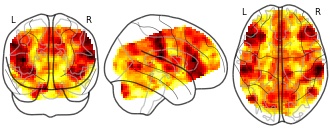
Collection description
The striking homogeneity of cerebellar microanatomy is strongly suggestive of a corresponding uniformity of function. Consequently, theoretical models of the cerebellum's role in motor control should offer important clues regarding cerebellar contributions to cognition. One such influential theory holds that the cerebellum encodes internal models, neural representations of the context-specific dynamic properties of an object, to facilitate predictive control when manipulating the object. The present study examined whether this theoretical construct can shed light on the contribution of the cerebellum to language processing. We reasoned that the cerebellum might perform a similar coordinative function when the context provided by the initial part of a sentence can be highly predictive of the end of the sentence. Using functional MRI in humans we tested two predictions derived from this hypothesis, building on previous neuroimaging studies of internal models in motor control. First, focal cerebellar activation–reflecting the operation of acquired internal models–should be enhanced when the linguistic context leads terminal words to be predictable. Second, more widespread activation should be observed when such predictions are violated, reflecting the processing of error signals that can be used to update internal models. Both predictions were confirmed, with predictability and prediction violations associated with increased blood oxygenation level-dependent signal in the posterior cerebellum (Crus I/II). Our results provide further evidence for cerebellar involvement in predictive language processing and suggest that the notion of cerebellar internal models may be extended to the language domain.
Subject species
homo sapiens
Modality
fMRI-BOLD
Cognitive paradigm (task)
contextual semantic priming task
Map type
T
- r
Data from: Differences in Encoding Strategy as a Potential Explanation for...
- resodate.org
Updated Dec 8, 2020ShareFacebookTwitterEmailClick to copy linkLink copiedCiteChristopher Hilton; Veronica Muffato; Timothy J. Slattery; Sebastien Miellet; Jan Wiener (2020). Differences in Encoding Strategy as a Potential Explanation for Age-Related Decline in Place Recognition Ability [Dataset]. http://doi.org/10.14279/depositonce-11019Unique identifierhttps://doi.org/10.14279/depositonce-11019Dataset updatedDec 8, 2020Dataset provided byTechnische Universität Berlin
DepositOnceAuthorsChristopher Hilton; Veronica Muffato; Timothy J. Slattery; Sebastien Miellet; Jan WienerDescriptionThe ability to recognise places is known to deteriorate with advancing age. In this study, we investigated the contribution of age-related changes in spatial encoding strategies to declining place recognition ability. We recorded eye movements while younger and older adults completed a place recognition task first described by Muffato et al. (2019). Participants first learned places, which were defined by an array of four objects, and then decided whether the next place they were shown was the same or different to the one they learned. Places could be shown from the same spatial perspective as during learning or from a shifted perspective (30° or 60°). Places that were different to those during learning were changed either by substituting an object in the place with a novel object or by swapping the locations of two objects. We replicated the findings of Muffato et al. (2019) showing that sensitivity to detect changes in a place declined with advancing age and declined when the spatial perspective was shifted. Additionally, older adults were particularly impaired on trials in which object locations were swapped; however, they were not differentially affected by perspective changes compared to younger adults. During place encoding, older adults produced more fixations and saccades, shorter fixation durations, and spent less time looking at objects compared to younger adults. Further, we present an analysis of gaze chaining, designed to capture spatio-temporal aspects of gaze behaviour. The chaining measure was a significant predictor of place recognition performance. We found significant differences between age groups on the chaining measure and argue that these differences in gaze behaviour are indicative of differences in encoding strategy between age groups. In summary, we report a direct replication of Muffato et al. (2019) and provide evidence for age-related differences in spatial encoding strategies, which are related to place recognition performance.
Probabilistic Computation in Human Perception under Variability in Encoding...
- plos.figshare.com
tiffUpdated Jun 3, 2023ShareFacebookTwitterEmailClick to copy linkLink copiedCiteShaiyan Keshvari; Ronald van den Berg; Wei Ji Ma (2023). Probabilistic Computation in Human Perception under Variability in Encoding Precision [Dataset]. http://doi.org/10.1371/journal.pone.0040216tiffAvailable download formatsUnique identifierhttps://doi.org/10.1371/journal.pone.0040216Dataset updatedJun 3, 2023AuthorsShaiyan Keshvari; Ronald van den Berg; Wei Ji MaLicenseAttribution 4.0 (CC BY 4.0)https://creativecommons.org/licenses/by/4.0/
License information was derived automaticallyDescriptionA key function of the brain is to interpret noisy sensory information. To do so optimally, observers must, in many tasks, take into account knowledge of the precision with which stimuli are encoded. In an orientation change detection task, we find that encoding precision does not only depend on an experimentally controlled reliability parameter (shape), but also exhibits additional variability. In spite of variability in precision, human subjects seem to take into account precision near-optimally on a trial-to-trial and item-to-item basis. Our results offer a new conceptualization of the encoding of sensory information and highlight the brain’s remarkable ability to incorporate knowledge of uncertainty during complex perceptual decision-making.
- w
Global Multichannel Video Encoder Market Research Report: By Application...
- wiseguyreports.com
Updated Sep 15, 2025+ more versionsShareFacebookTwitterEmailClick to copy linkLink copiedCite(2025). Global Multichannel Video Encoder Market Research Report: By Application (Broadcasting, Surveillance, Video Conferencing, Streaming Services), By Encoding Type (H.264, H.265, MPEG-2, AVC), By Deployment Type (On-Premises, Cloud-Based, Hybrid), By End Use (Media and Entertainment, Education, Corporate, Government) and By Regional (North America, Europe, South America, Asia Pacific, Middle East and Africa) - Forecast to 2035 [Dataset]. https://www.wiseguyreports.com/reports/multichannel-video-encoder-marketDataset updatedSep 15, 2025Licensehttps://www.wiseguyreports.com/pages/privacy-policyhttps://www.wiseguyreports.com/pages/privacy-policy
Time period coveredSep 25, 2025Area coveredGlobalDescriptionBASE YEAR 2024 HISTORICAL DATA 2019 - 2023 REGIONS COVERED North America, Europe, APAC, South America, MEA REPORT COVERAGE Revenue Forecast, Competitive Landscape, Growth Factors, and Trends MARKET SIZE 2024 5.64(USD Billion) MARKET SIZE 2025 6.04(USD Billion) MARKET SIZE 2035 12.0(USD Billion) SEGMENTS COVERED Application, Encoding Type, Deployment Type, End Use, Regional COUNTRIES COVERED US, Canada, Germany, UK, France, Russia, Italy, Spain, Rest of Europe, China, India, Japan, South Korea, Malaysia, Thailand, Indonesia, Rest of APAC, Brazil, Mexico, Argentina, Rest of South America, GCC, South Africa, Rest of MEA KEY MARKET DYNAMICS growing demand for streaming services, increasing adoption of 4K content, advancements in encoding technologies, rise in digital broadcasting, expanding media and entertainment industry MARKET FORECAST UNITS USD Billion KEY COMPANIES PROFILED Elemental Technologies, Matrox, Miranda Technologies, Zixi, Mediacore, AJA Video Systems, Haivision, Vitec Group, Ateme, Blackmagic Design, Wowza Media Systems, Teradek, Cisco Systems, Harmonic, Telestream MARKET FORECAST PERIOD 2025 - 2035 KEY MARKET OPPORTUNITIES Rising demand for OTT services, Increased adoption of 4K content, Expansion of live streaming platforms, Growing need for cost-effective solutions, Integration of AI in encoding processes COMPOUND ANNUAL GROWTH RATE (CAGR) 7.1% (2025 - 2035) - s
Visual encoding and age-related deficits in object location memory: Evidence...
- eprints.soton.ac.uk
Updated May 5, 2023ShareFacebookTwitterEmailClick to copy linkLink copiedCiteLiversedge, Simon P; Shih, Shui-I (2023). Visual encoding and age-related deficits in object location memory: Evidence from eye movements [Dataset]. http://doi.org/10.5255/UKDA-SN-850457Unique identifierhttps://doi.org/10.5255/UKDA-SN-850457Dataset updatedMay 5, 2023Dataset provided byUK Data ArchiveAuthorsLiversedge, Simon P; Shih, Shui-IDescriptionWith age, object-location memory performance has been shown to reduce, and older adults recall fewer object locations than younger adults. However, to date, no research has investigated the role of eye movements during encoding of scenes in relation to memory for object-location information. Furthermore, there has been no investigation of whether differences in encoding behaviour with age relate to subsequent memory recall. Using eye-tracking methodology, we aim to conduct three experiments to explore how eye movements during scene inspection change in relation to age, and in relation to recall performance. Specifically, we will systematically explore the influence of encoding instruction, object-distractor similarity and the influence of attentional cueing at encoding on patterns of eye movements and object-location memory performance in younger and older adults. We will also assess the extent to which object-location memory is poorer than either object memory or location memory, and whether these effects are disproportionately larger in older compared to younger adults. From our findings, we aim to provide a clear theoretical account of the relationship between encoding processes associated with scene perception, the cognitive processes underpinning object-location memory, and the extent to which age-related differences in encoding processes are associated with differential age-related decline.

Not seeing a result you expected?
Learn how you can add new datasets to our index.
FacebookTwitterEmailClusters with significantly different ReHo Ratio between the two APOE groups in Encoding-related ROI.
Clusters with significantly different ReHo Ratio between the two APOE groups in Encoding-related ROI.